What You're Looking At
Oodi is Helsinki's central library, opened in December 2018 and designed by ALA Architects. It sits directly opposite the Finnish Parliament building — a deliberate piece of symbolism. The building is 17,000 square metres across three floors, each with a distinct purpose: ground floor for events and orientation, second floor for making and working, third floor for reading and being still. It receives roughly 10,000 visitors a day.
This audit documents the experience of moving through Oodi as a first-time visitor on a weekday afternoon.
Flow
9/10Intuitive vertical pumping via DNA stairs
Movement through the building is remarkably legible. The ground floor is open and high-ceilinged, making orientation immediate upon entry. You can see the central staircase — a double helix that spirals upward through all three levels — within seconds of walking in.
Each floor has a different spatial character that signals its function without requiring signage. The second floor is dense and workshop-like. The third floor opens into a wide, light-filled landscape. The transitions between these zones are intuitive: you feel the shift before you read it.
There are moments where flow is less clear — particularly on the second floor, where maker spaces, recording studios, and meeting rooms are arranged behind partitions. The layout rewards exploration but doesn't always reward urgency.
Walking time from entrance to the furthest point on the third floor: approximately 4 minutes at a relaxed pace.
Wayfinding
7/10High latency for first-time visitors on 2F
Wayfinding at Oodi operates on multiple layers. The primary system is spatial: the building's form does most of the work. The staircase is always visible. Natural light from the third-floor skylights pulls you upward. Surface materials change between floors — polished concrete gives way to birch — providing haptic cues about where you are.
For visitors who need explicit guidance, there are tactile strips in the flooring leading to lifts, service points, and facilities. Tactile maps are available on each floor. Braille is present on all signage and embedded behind stair handrails.
A sound beacon at the southern entrance uses a custom acoustic signal developed with visually impaired users. It acts as a locator, directional guide, and meeting point simultaneously.
Where wayfinding weakens: the second floor. The partition layout makes it harder to maintain a mental model of the space. If you're looking for a specific studio or meeting room, you'll likely need to ask.
Friction
9/10Near-zero barriers from entrance to use
Friction is minimal. The entrance uses motion-sensor doors — no handles, no barriers. There are three accessible lifts and multiple staircase options. No ticket, no registration, no gate. You walk in and you're in.
Self-service stations for borrowing and returning books are scattered across the third floor and work without staff interaction. The café and restaurant on the ground floor operate independently from the library — you don't pass through a checkout to reach them.
The only friction points observed: occasional congestion near the lift lobbies on the second floor during busy periods, and a lack of clear indication of which meeting rooms are available versus occupied. Neither is significant.
Comfort
9/10Third floor sets the standard for public interiors
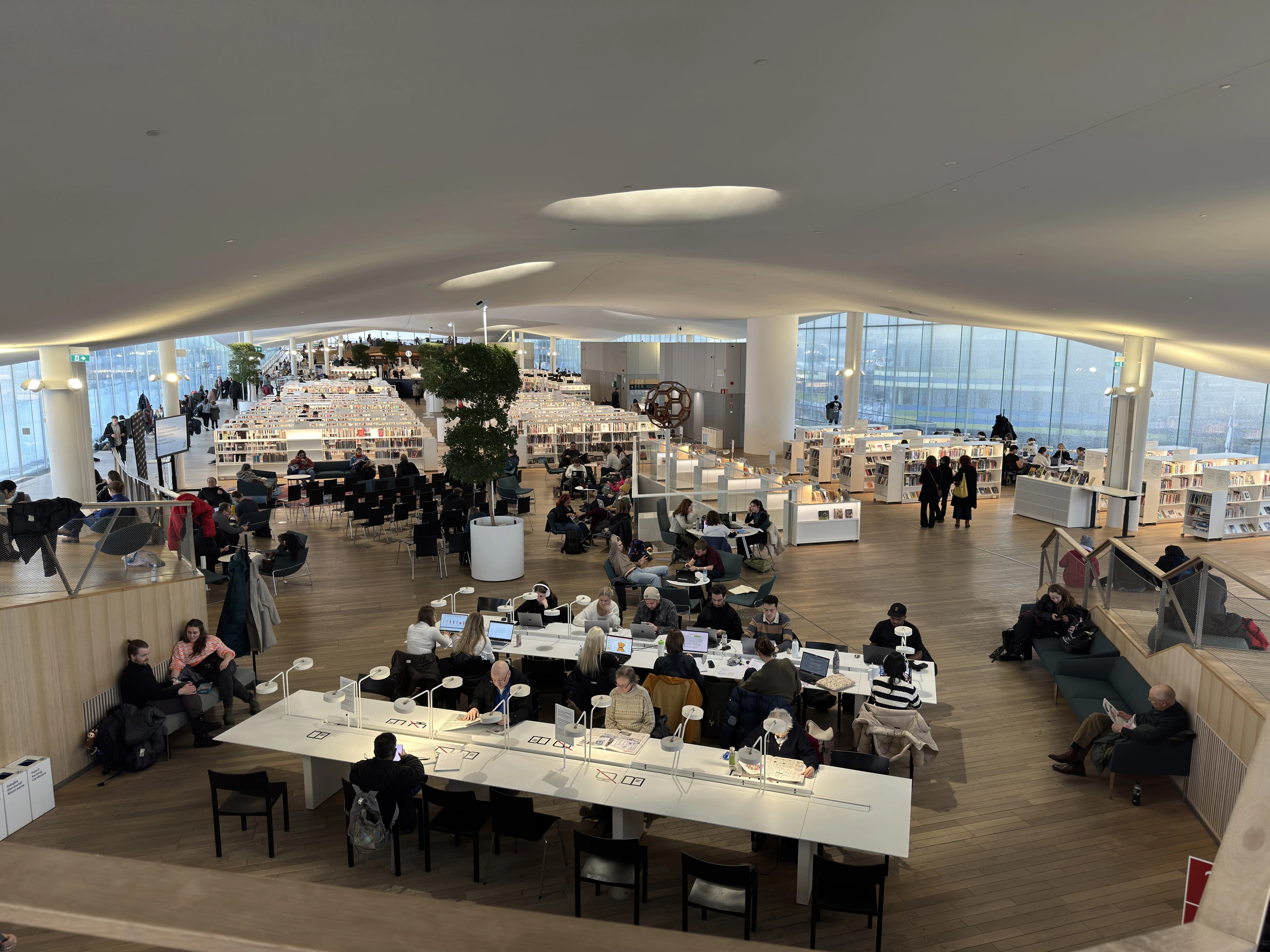
This is where Oodi excels. The third floor — "book heaven" — is one of the most comfortable public interiors in Northern Europe. The undulating acoustic ceiling creates a sense of shelter without enclosure. Natural light pours through skylights and floor-to-ceiling glazing along the north face. Views extend across the city toward Töölönlahti Bay.
Seating is varied and generous. Sculptural armchairs, pill-shaped reading chairs, window benches, and traditional desks are distributed across the floor. There is no single "correct" way to sit. Power outlets are available at most seating positions.
Temperature regulation is excellent — the building's ventilation system is designed to be inaudible, and on the day of this audit, the climate was consistent across all three floors despite the glass envelope.
The public terrace on the top floor is accessible year-round and offers views over the Kansalaistori civic square.
Sound
8/10Successful zoning through ceiling geometry
Acoustics were a central concern in the design. The third floor uses 4,450 square metres of Class A acoustic ceiling tiles (Rockfon Mono Acoustic) to manage sound in the open-plan reading landscape. The result: even at moderate occupancy, the space feels calm. Conversations happen at table level without carrying.
The second floor is deliberately louder — it houses maker equipment, recording studios, and group work areas. Sound separation between these zones and the reading floor above is effective. You don't hear the laser cutter from the armchairs.
Music studios and the ground-floor theatre are engineered to 25 decibels, while offices and meeting spaces operate at 33 decibels. The ventilation system routes through walls, floors, and shelving rather than exposed ductwork, keeping mechanical noise out of occupied spaces.
The only acoustic compromise: the ground floor entrance hall echoes slightly during peak hours due to the hard floor and high ceiling. This seems intentional — it reads as civic rather than intimate.
Accessibility
9/10Zero-threshold design with acoustic wayfinding
Oodi is one of the most accessible public buildings we've documented. The design brief explicitly required "zero-threshold" access, and the execution is thorough.
All entrances are step-free with motion-sensor doors. Lifts are available on every floor. Tactile guidance strips run through all primary routes. Blister paving warns of stairs. Induction loops are installed at service desks and in the auditorium. Accessible toilets are available on multiple floors.
The sound beacon at the southern entrance is a standout detail — a purpose-designed acoustic wayfinding tool created in collaboration with visually impaired users. It provides orientation without requiring any device or app.
Furniture and workstations include height-adjustable options. Self-service machines are reachable from a seated position.
Where it could improve: the second-floor maker spaces involve equipment that requires physical dexterity (3D printers, laser cutters, sewing machines), and assisted access to these tools isn't always immediately available without advance booking.
